Concrete slump testing is one of the most common field tests performed during concrete placement — and one of the quickest ways to evaluate the consistency and workability of fresh concrete before it hardens.
Whether used on commercial buildings, municipal infrastructure, industrial projects, or site development work, slump testing helps project teams identify potential concrete quality issues before placement and finishing begin.
Below is an overview of how concrete slump testing works, what slump values indicate, and why proper testing procedures matter in the field.
Q: What is the “slump” of concrete?
A: “Slump” refers to the consistency or workability of freshly mixed concrete before it hardens.
The slump value is the vertical distance between the original height of a filled slump cone and the highest point of the concrete after the cone is removed and the concrete settles.
In simple terms, slump testing measures how stiff or fluid a concrete mix behaves immediately after batching.
Q: How does a concrete slump test work?
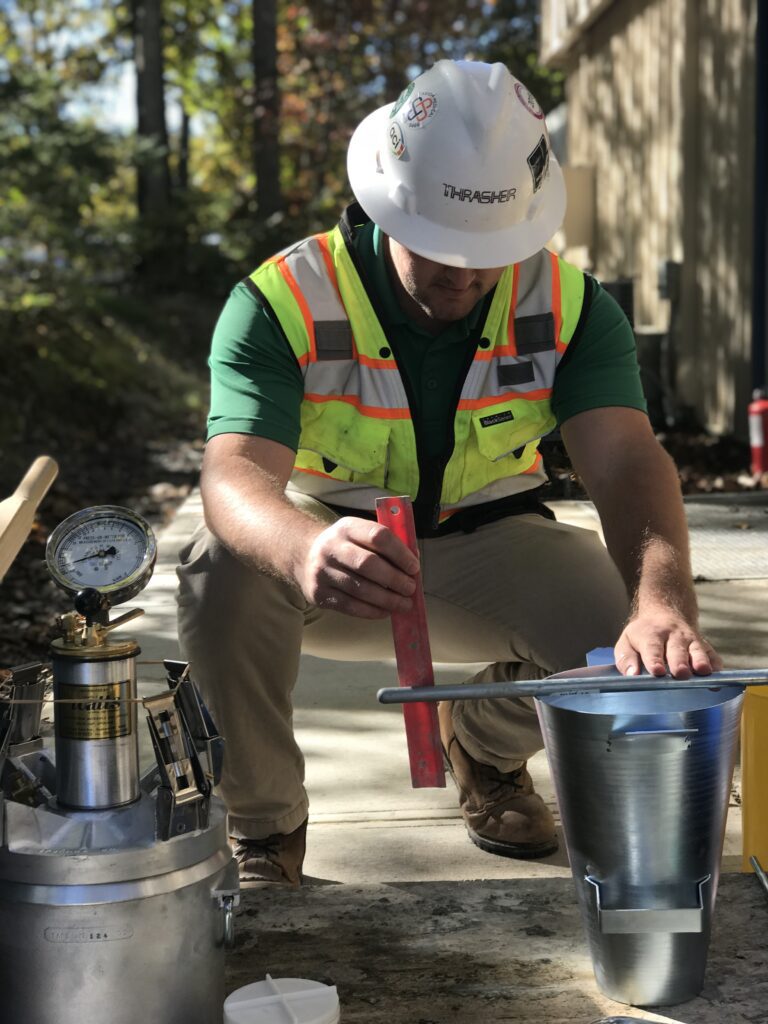
A: A concrete slump test is performed using a cone-shaped mold in accordance with ASTM C143 procedures.
During the test:
- The slump cone is dampened and placed on a level surface
- Fresh concrete is placed into the cone in equal layers
- Each layer is rodded to consolidate the material and remove trapped air
- The cone is carefully lifted vertically
- The concrete settles or “slumps” downward
- The vertical drop is measured in inches
The measured slump value provides a quick indication of the concrete mix’s workability and consistency.
Q: What does slump tell you about a concrete mix?
A: Slump testing helps indicate how easily concrete can be placed, consolidated, and finished.
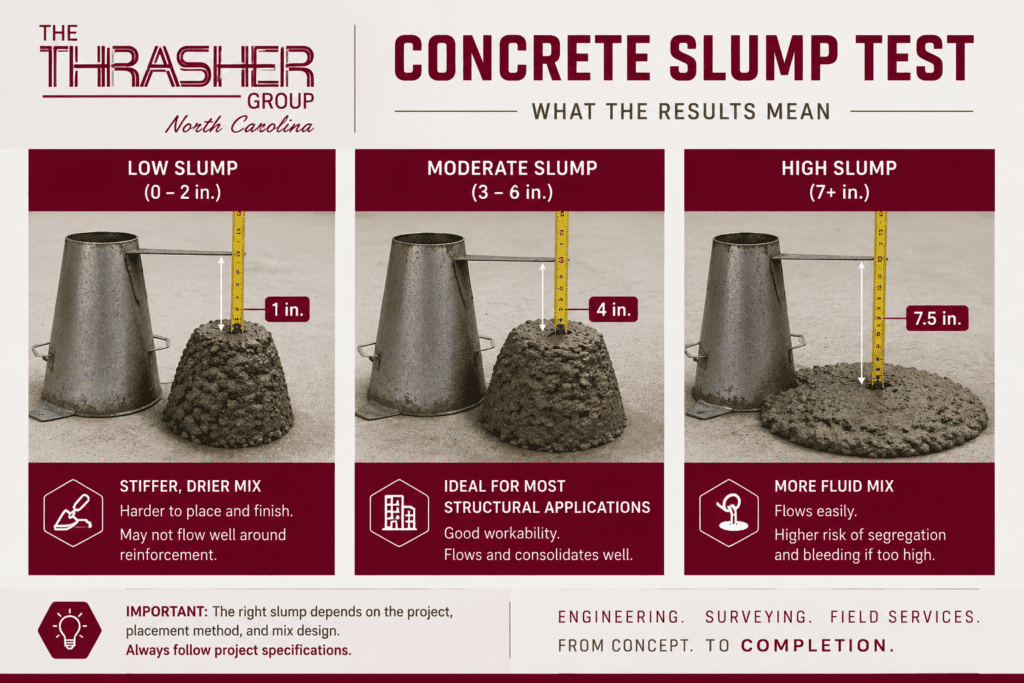
Typical slump ranges include:
- Less than 3 inches → relatively stiff concrete
- 3 to 6 inches → common range for many applications
- Greater than 6 inches → highly workable or fluid concrete
The ideal slump depends on the application, placement method, reinforcement congestion, and mix design requirements.
Q: Why is slump testing important?
A: Slump testing serves as a fast field quality control check during concrete placement.
Consistent slump values help indicate that batches from the same mix design are being produced uniformly. Unexpected changes in slump can sometimes signal:
- Excess water added to the mix
- Inconsistent batching
- Air content variations
- Material segregation
- Potential workability or finishing issues
Proper workability is important because concrete must flow adequately into forms and around reinforcement without excessive voids or segregation.
Slump testing helps identify potential problems before placement is completed, reducing the risk of performance issues, finishing difficulties, or inconsistent concrete quality later.
Q: Why does proper slump testing technique matter?
A: While slump testing is relatively straightforward, improper technique can produce misleading or inaccurate results.
Testing personnel performing ASTM C143 procedures should understand:
- Proper cone preparation
- Correct layer placement and consolidation
- Consistent rodding technique
- Proper cone lifting speed and direction
- Accurate measurement procedures
For this reason, slump testing is commonly performed by trained or certified field technicians (ACI Grade 1 or higher) familiar with concrete testing procedures and quality control standards.
Q: Why is slump testing sometimes called a “cone test”?
A: The test is sometimes informally called a “cone test” because of the cone-shaped mold used during the procedure.
After the cone is filled and lifted, the concrete settles under its own weight. The amount the concrete drops or “slumps” becomes the measured slump value.
Q: Is slump testing the only concrete field test performed on projects?
A: No. Slump testing is often performed alongside several other fresh concrete and laboratory tests depending on project requirements. Common related testing services include:
- Concrete compressive strength testing
- Concrete cylinder testing
- Air content testing
- Concrete temperature testing
- Unit weight and density testing
- Aggregate testing
- Soil and compaction testing
Together, these tests help provide a more complete understanding of concrete quality and compliance during construction.
Q: What types of projects commonly require slump testing?
A: Concrete slump testing is commonly performed on:
- Commercial construction projects
- Municipal infrastructure work
- Foundations and slabs
- Retaining walls
- Industrial facilities
- Transportation and roadway projects
- Site development and utility projects
Testing requirements are typically defined by project specifications, mix designs, engineering requirements, or quality assurance programs.
Concrete Slump Testing Services Near You
The Thrasher Group NC provides concrete field testing, laboratory testing, and construction materials testing services in our North Carolina-based accredited lab. Our team supports contractors, developers, municipalities, and engineers with:
- ACI-certified field technicians
- ASTM concrete testing procedures
- AASHTO accredited laboratory services
- CCRL accredited concrete testing
- Field and laboratory concrete quality testing
Need assistance with concrete slump testing, strength testing, or construction materials testing for an upcoming project? Contact The Thrasher Group NC to learn more about our testing capabilities across North Carolina.