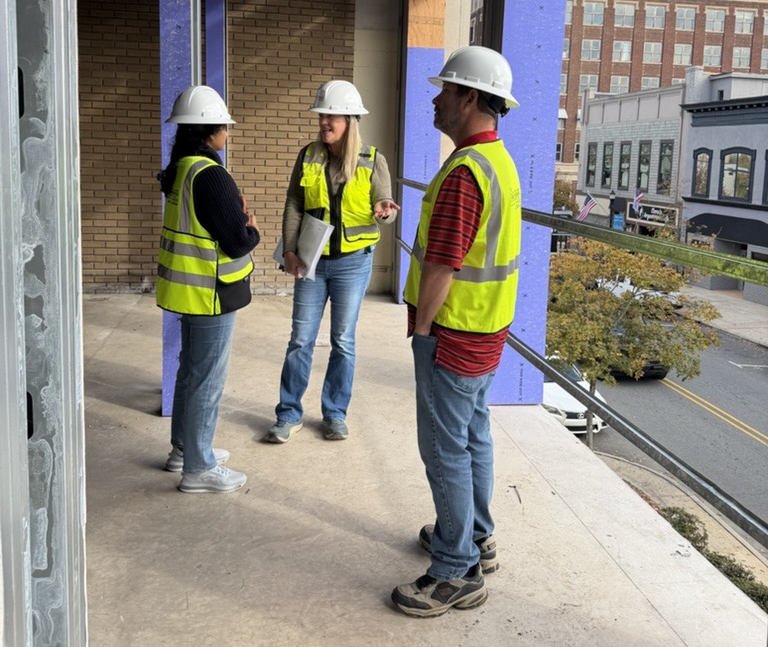
With 25 years of structural engineering experience, Larissa Coles has worked on everything from commercial buildings and industrial facilities to community landmarks like the Charlotte Hindu Center.
Having grown up around construction and spent 13 years working in a family-owned architecture and engineering business, Larissa brings a practical perspective to every project. Her experience spans office buildings, churches, hotels, retaining walls, and specialized structures for manufacturing and industrial facilities.
Today, as part of The Thrasher Group North Carolina’s structural engineering team, she works closely with civil engineers, surveyors, contractors, and clients to develop solutions that work not just on paper, but in the field.
We sat down with Larissa to discuss the challenges of working with existing structures, the value of collaboration, and why curiosity remains essential to good engineering.
Designed for the Building — Not Just the Blueprint
You have a lot of experience working with existing structures. What makes those projects different from designing new buildings?
Existing buildings come with challenges that aren’t always apparent in the original drawings. Before designing a modification, engineers need to understand how a structure was built, what condition it’s in, and whether it can safely accommodate the proposed changes.
That can mean evaluating foundations, identifying existing supports, or determining how new framing will interact with older construction.
For Larissa, the key is understanding the building as it actually exists, rather than relying solely on what the drawings suggest. Getting on-site to see those conditions firsthand can make all the difference.
Tell us about a commercial project you’re currently working on. What makes it interesting from a structural engineering standpoint?
One of Larissa’s current projects involves the adaptive reuse of the former Citizens National Bank building on Main Street in Gastonia, North Carolina.
The building is being repurposed for commercial lease space, requiring structural modifications that accommodate its new use while working within the original construction.
Larissa is preparing metal framing drawings for the contractor and coordinating the design around the building’s existing conditions. Because the structure was originally designed as a bank, it includes unique components that must be considered during renovation.
Projects like this require balancing the proposed improvements with the realities of an existing building, often under tight construction schedules.
What about projects where a seemingly simple repair turns into something more involved?
Larissa points to plans for the reconstruction of the baseball dugouts at local high school.
The original request was to replace the dugout roofs, which had developed significant sagging in their steel structural members. But a closer evaluation revealed that the existing walls lacked proper foundations.
Simply replacing the roofs wouldn’t address the underlying structural deficiencies. Instead, the project required a more comprehensive approach to rebuilding the dugouts.
The fact that spectators, including parents, sometimes sat on top of the dugouts made those structural concerns especially important.
For Larissa, the project illustrates a fundamental principle of structural engineering: The best solution isn’t always the one that initially appears to be the simplest.
One Team, Better Coordination
One advantage of working with The Thrasher Group NC is having civil engineering, structural engineering, and surveying expertise under one roof. How does that impact your work?
For Larissa, one of the biggest advantages is how quickly the team can communicate and adjust designs as projects evolve.
“I can just walk next door and say, ‘Mark, can you give me an updated grading plan so I can make any adjustments to the retaining wall height?'”
“I’m not waiting days for someone to respond to my request.”
That immediate communication is especially valuable when civil and structural designs depend on one another. A grading change, for example, can affect the height, location, or even the need for a retaining wall.
At Thrasher NC, those conversations can happen in real time. Weekly project huddles also give the team opportunities to discuss ongoing work, identify potential issues, and coordinate across disciplines.
Can you give us an example of a project where that collaboration made a difference?
One example is the new Holy Angels Learning Center in Belmont, North Carolina, where Thrasher NC is providing both civil and structural engineering services.
The original design included a retaining wall, but as the civil engineering plans evolved, changes to the grading eliminated the need for the wall in that location.
Because the civil and structural teams were working together, they could evaluate the changes and adjust the design accordingly, helping the client avoid an unnecessary construction element and its associated costs.
Similar coordination comes into play when surveying information or septic system locations affect building placement and structural design.
Having multiple disciplines working together allows the team to identify opportunities, respond to changes, and resolve potential issues before they become costly problems in the field.
Built for North Carolina’s Real-World Conditions
You’ve worked on projects throughout North Carolina. How important is understanding local conditions when designing a structure?
For Larissa, understanding what’s happening at a project site is essential. While structural engineering relies on established design principles, real-world conditions don’t always fit neatly into a textbook example.
“You don’t have to be on site or be local, but it helps a lot,” she explains. “If it’s a larger project, you really have to see it.”
Soil conditions, elevation changes, existing materials, and construction access can all influence a design. Those considerations become especially important when repairing infrastructure or rebuilding damaged structures.
You’ve also been involved in flood recovery work around Lake Lure. What has that experience taught you about working with existing conditions?
In September 2024, Hurricane Helene brought catastrophic flooding, landslides, and widespread destruction to western North Carolina, including Asheville, Chimney Rock, Lake Lure, and surrounding communities.
One of Larissa’s projects involves reconstructing seawalls near the Lake Lure Flowering Bridge. The historic bridge, which had been converted into a pedestrian attraction, sustained significant flood damage.
After a Thrasher NC colleague evaluated the damaged structure and recommended demolition, its removal left a gap in the adjacent seawall. Larissa was tasked with developing plans to rebuild that section.
But the design required much more than determining the dimensions of the missing wall.
“When you’re tying into something to rebuild, what are the dimensions? What are the materials? What is the soil like? What’s the elevation difference?”
Water levels and construction access added another layer of complexity. The team had to consider where equipment could operate and how the new seawall would connect to the remaining structure.
“Your field conditions dictate so much.”
It’s a perspective Larissa carries into every project, whether she’s working on commercial renovations, industrial facilities, or infrastructure recovery.
Experience That Strengthens Every Project
How has your background shaped the way you approach structural engineering today?
Larissa’s years in the industry have given her an appreciation for both the technical and practical sides of engineering. She’s worked through changing economic conditions, adapted to different project demands, and gained experience across a wide range of structures.
That variety is part of what keeps the work interesting.
“I love to work with the Water Resources group because I’ve seen different construction and big concrete tanks, and it’s fun for me.”
Structural engineering plays an important role in water and wastewater projects, from supporting equipment to designing large concrete structures. Larissa enjoys contributing her experience while continuing to learn from engineers in other disciplines.
What do you think sets The Thrasher Group NC’s approach to structural engineering apart?
For Larissa, it comes down to commitment, experience, and the relationships that make collaboration possible.
“There are many structural engineers. I just know that we always try to give 100% to our projects.”
That commitment goes beyond producing drawings and calculations. It means being available when colleagues need input, helping solve unexpected problems, and taking ownership of the finished result.
And while having colleagues just down the hall makes communication easier, the real value comes from the experience and expertise they bring to each project.
The Reward of Seeing a Finished Building
After 25 years in structural engineering, what makes the work rewarding?
For Larissa, one of the most satisfying parts of the job is seeing a finished project become part of the community.
After working on buildings and structures across North Carolina, she can drive through familiar places and recognize projects she helped bring to life.
“I’ve done this a long time, and I love driving through places and saying, ‘I worked on that.'”
That sense of pride and ownership has stayed with her throughout her career.
“It’s not just an 8-to-5 job. It’s something you carry with you.”
For Larissa, structural engineering is about more than making sure a design works on paper. It’s about understanding how a structure will be built, how it will perform, and how it will serve the people who use it.
And after 25 years, the reward remains the same: seeing a finished structure and knowing she helped make it possible.
Ready to talk to The Thrasher Group NC about your next commercial, industrial, or structural engineering project?
Larissa Coles
lcoles@thethrashergroupnc.com
(704) 864-2201