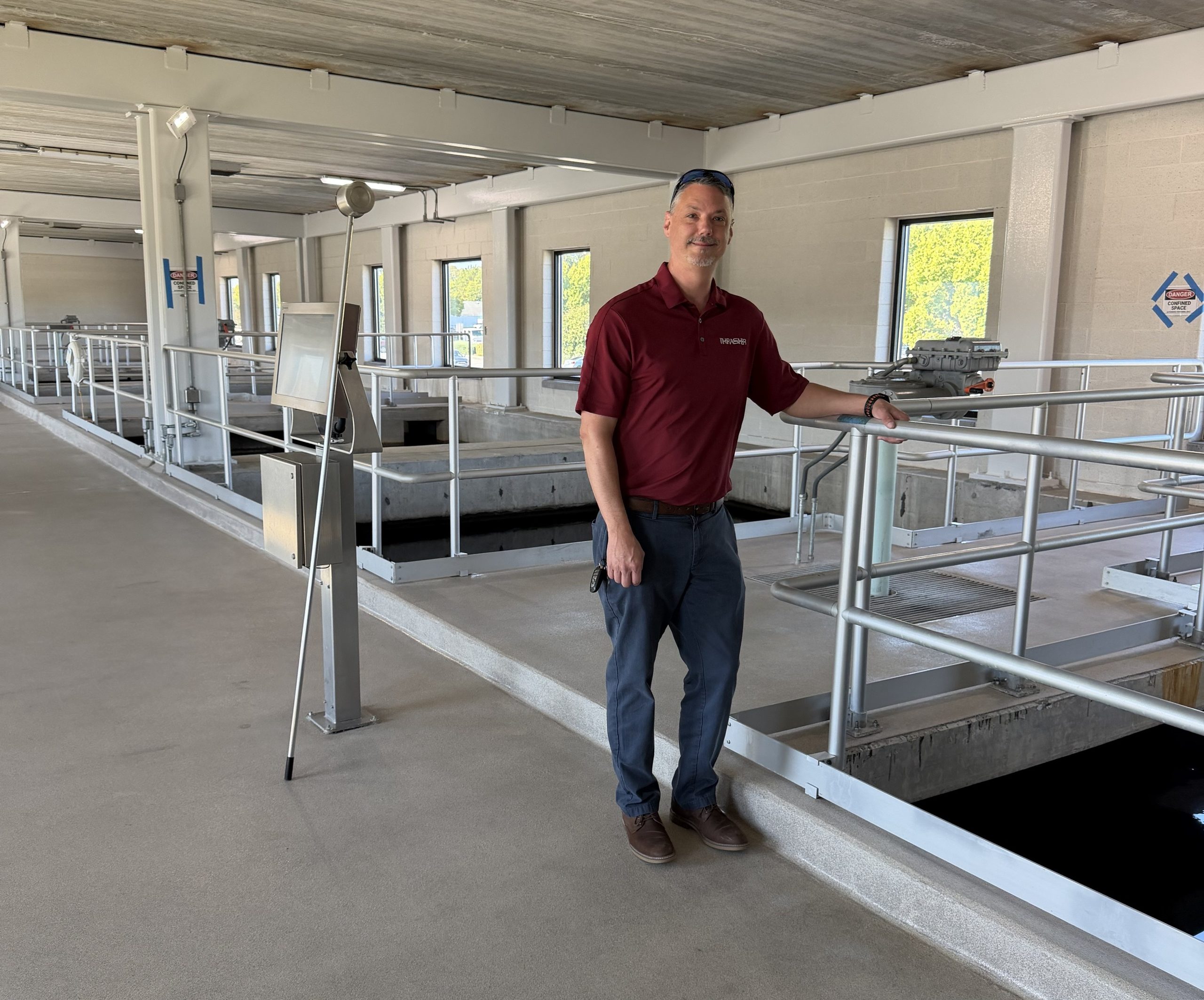
Rusty Campbell has spent 30 years in the water resources industry — 27 of them on the public utility side, starting out as a lab chemist, before working his way through operations and into leadership.
That hands-on foundation shapes everything he does today as head of The Thrasher Group North Carolina’s Water Resources division.
We sat down with Rusty to talk about the four key values that guide his team’s work, the stories behind them, and how his background with municipal utilities and NCDEQ informs the way Thrasher NC serves its clients.
Engineered for Compliance
You say you want The Thrasher Group NC to be known for its “engineered for compliance” approach. Can you tell us about a time when that really mattered?
“Regulatory compliance is where a lot of our work starts, and the EPA’s Lead and Copper Rule (which is designed to protect drinking water from lead and copper that leach from pipes, solder, fixtures and services lines) is a good example of just how demanding that can be. Every water system has to remove lead service lines from their systems within 10 years, which means evaluating all piping material in the system. That’s a massive undertaking — you can conduct a predictive model, and you need field crews out there doing service line inventories, finding the people who can actually go do that work, and making sense of what’s buried in the ground.”
“As regulations change, water engineering firms have to be prepared to help their customers adapt. The new PFAS regulatory timeline is another good example. It’s expensive to get into compliance, and there’s still a lot of unknowns out there about where EPA regulation is headed in the future. A good engineering firm can help navigate this with a client and engineer water systems with regulations in mind from the start. Thrasher continues to stay up to date with the regulatory changes and nuances so we can best advise our clients and maximize their funding while meeting regulatory requirements.”
“It means we take every single precaution and step to avoid making errors — and every step is done thoroughly, start to finish. One example of how that shows up practically is how we handle NCDEQ reviews. Once a design reaches the 60% or 90% stage, we’ll send it to NCDEQ for a cursory review before it ever goes into the formal review process.”
Tell us more about PFAS removal and how that will impact the water engineering work in North Carolina.
“PFAS removal comes down to a few different technology paths — physical barriers, ion exchange, GAC, and other methods being researched — and utilities often need an engineering partner to help figure out which one will work best for the unique water system. Thrasher NC is talking with a partner that offers physical barrier systems, and we could help design the system to fit into an existing plant, engineered so it can be installed and approved to plug into a system to help them meet the stringent regulatory requirements. That’s the kind of problem-solving compliance work is really about — not just meeting the letter of the regulation, but making the solution fit the real, physical plant you’re working with.”
Responsiveness matters a lot for compliance. Any recent examples?
“We had a client email us on June 30th, the last day of their fiscal year with an urgent documentation request. We had everything they needed together and sent it back to them that same morning — start to finish, in less than an hour. Getting this information to the client in a timely manner can be the difference between them securing or not securing a loan or funding for a water or wastewater project.”
Designed for Performance
“Designed for performance” is the second value on your list. What does that mean in practice, and can you give an example?
One story Rusty points to involved a wastewater treatment plant in NC. Thrasher NC connected with the utility at the NC Main Street Conference, where a small photo of one of Thrasher NC’s water basin designs caught their attention.
“The plant was dealing with disruptions during high-flow events — heavy rain would hit the system and throw off internal operations enough to cause frequent NOVs (notices of violation) from the State of North Carolina’s Department of Environmental Quality (NCDEQ). We toured the plant extensively, talked with the wastewater superintendent and operators, and worked through ideas together for a temporary, interim solution to keep the notices at bay while the long-term fix can be designed and constructed.
A long-term answer may be EQ basin space — equalization basin capacity that lets the plant absorb those high-flow events instead of getting knocked off balance by them. Our job will be to help them go after the funding, create the design, handle the permitting, and manage construction administration and everything in between to get there.”
“It’s a multi-year project, and funding timing doesn’t always cooperate — you plan around fall or spring funding cycles and sometimes there’s a delay. But that’s the performance piece: designing a long-term solution that actually solves the root cause and doing so within the confines of regulating agencies and funding opportunities.”
“But that’s the performance piece: designing a long-term solution that actually solves the root cause.”
Built for North Carolina
What does “Built for North Carolina” mean to you? Is that specifically about NCDEQ approval, or something broader?
“It starts with understanding how NCDEQ operates. EPA sets the baseline rules and NCDEQ holds primacy for enforcing it in North Carolina. So being built for North Carolina means we design and engineer with NCDEQ’s specific standards and review process in mind from day one — not retrofitting a generic approach after the fact.”
“That’s really where my background comes in. I spent 30 years in this industry in North Carolina, 27 of those on the public utility side, starting in the lab and working through operations. I know what it’s like to sit on the other side of the table as a utility, and I’ve built relationships with NCDEQ over decades. Understanding both sides of that relationship is what lets us build projects that fit North Carolina’s regulatory environment, not a more generic standard.”
Done Right the First Time
What does “done right the first time” mean to you, and what does it mean for your customers?
“It means we take every single precaution and step to avoid making errors — and every step is done thoroughly, start to finish. One example of how that shows up practically is in how we handle NCDEQ reviews. Once a design reaches the 60% or 90% stage, we’ll send it to NCDEQ for a cursory review before it ever goes into the formal review process. That’s not something required though NCDEQ is kind enough to assist with that as part of our process, but it’s an extra step that can save both time and money in the long run.”
“That cursory step lets us catch and mitigate issues before they become official comments — things we can often address in a very short time — whether a linear project has enough air releases or other appurtenances , whether the geotech and compaction rates are correct, and so many other things that can be caught early. Of course this isn’t a full review, but they’re picking out the things that can be addressed quickly. It also means we’re not paying a permitting or review fee for that early look, and more importantly, we’re not adding 15 to 30 days to the schedule by discovering the same comments and dealing with changes later in a full formal review.”
Can you tell us about a “done right the first time” moment — something that could have gone sideways, or have been much more complicated, without your expertise?
Before joining The Thrasher Group North Carolina, Rusty spent years on the utility side, including at a NC municipality outside of Charlotte.
“When I first started, we faced a notice of violation. Instead of spending capital to hire an outside engineering firm to fix it, we were able to solve the issue with some simple operational adjustments at the plant. That kind of hands-on, plant-optimization mindset is a differentiator for our team now — we’re not just designing on paper, we understand what’s happening at the plant level.”
Thanks Rusty! In Closing?
“From source water to tap water to wastewater, I’ve been heavily involved in it all and we understand what it takes to get the job done right,” he says. “And that’s exactly the perspective we bring to every project.”
Ready to talk to The Thrasher Group NC about your next water systems or wastewater project(s)? Contact Us
Rusty Campbell
rcampbell@thethrashergroupnc.com
(704) 864-2201